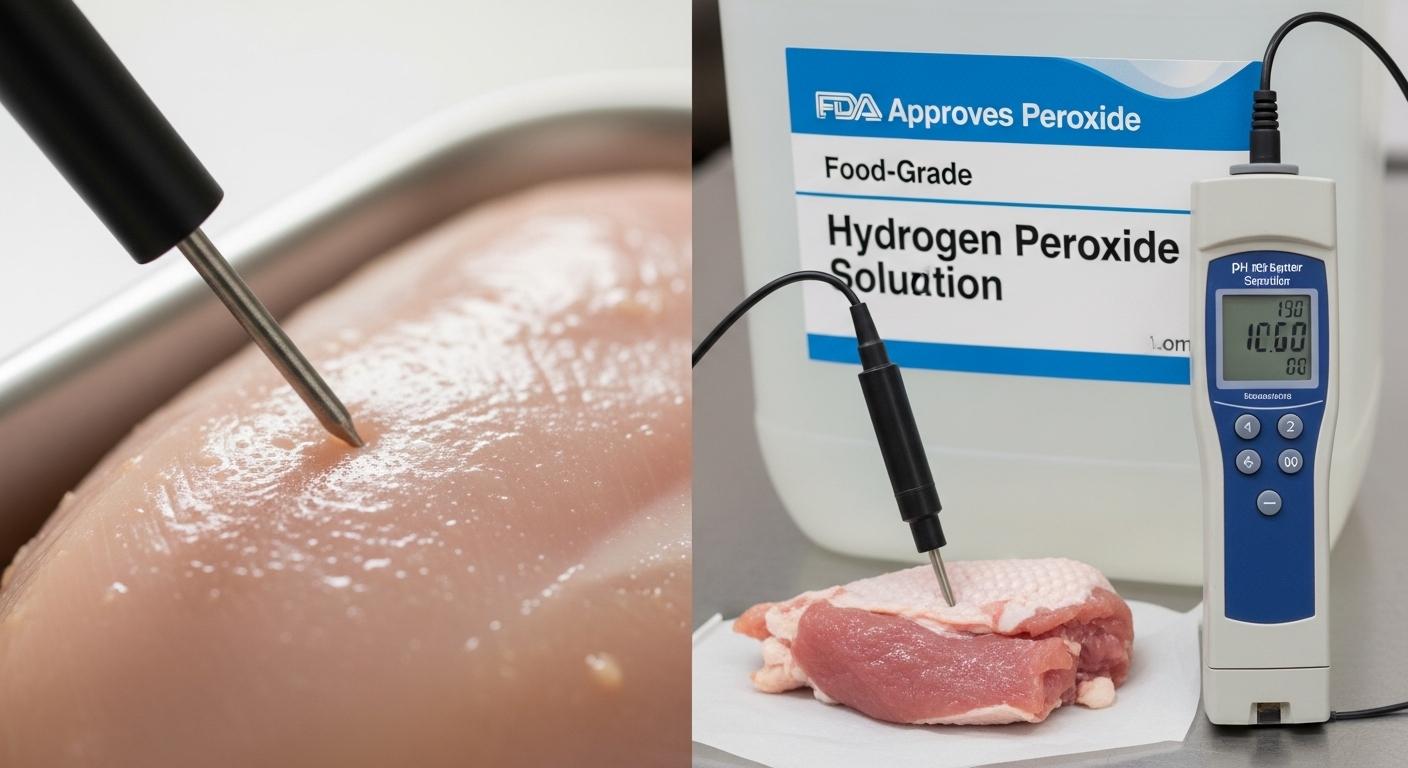
FDA Approves Hydrogen Peroxide for Meat and Poultry Processing
The same chemical you use to disinfect cuts and scrapes can now be used directly on the chicken breast or ground beef you feed your family. On September 3, 2025, the FDA amended its food additive regulations to permit hydrogen peroxide in meat and poultry processing, a significant expansion that raises new questions about processing chemicals in American food.
The regulatory change came in response to a petition filed by Cargill, one of the world's largest food companies. The FDA's final rule allows hydrogen peroxide to be used as an antimicrobial agent, oxidizing and reducing agent, and bleaching agent in food production, including meat and poultry. The rule took effect immediately upon publication in the Federal Register.
Context
Hydrogen peroxide is a common household disinfectant, familiar to most Americans as the bubbling liquid in brown bottles under bathroom sinks. In industrial settings, it has long been used for surface sanitization and cleaning. The FDA previously permitted limited use of hydrogen peroxide in certain food applications, but the September 2025 amendment represents the first time the agency has explicitly approved its use in meat and poultry processing.
The expanded clearance under 21 CFR 173.356 permits food-grade hydrogen peroxide that meets specifications in the 14th edition of the Food Chemicals Codex. The FDA updated the regulation from the previously referenced 7th edition, indicating the agency's effort to align with current industry standards.
Here's the catch. According to the Federal Register notice, "Residual hydrogen peroxide must be removed from food during processing by appropriate chemical or physical means." The FDA requires complete elimination of any trace residues before products reach consumers.
But how is "complete removal" verified? And what happens when processors don't fully comply?
The Findings
The FDA's decision to expand hydrogen peroxide use follows a formal petition process initiated by Cargill. The company requested permission to use hydrogen peroxide in food, including meat and poultry, in accordance with good manufacturing practices. The FDA evaluated safety data and determined the expanded use poses no risk, provided residues are completely removed.
The amendment also removed sulfur dioxide from the regulation as part of the update. Food Safety Magazine reported that the new rule permits hydrogen peroxide as an antimicrobial agent, oxidizing and reducing agent, and bleaching agent. These functions give food processors multiple tools to control bacteria, modify food chemistry, and alter food appearance during production.
The National Law Review noted that the expansion made hydrogen peroxide a more versatile processing tool across the food industry. The Daily Intake reported that parties had until October 3, 2025 to file objections or request a hearing on the order, providing a 30-day window for public comment.
Industry response was swift and enthusiastic. TOMI Environmental Solutions, a company that produces hydrogen peroxide-based antimicrobial technology, announced in a September 18 press release that the FDA ruling "significantly expands potential application" of its SteraMist technology in the food industry. The company viewed the regulatory change as opening new commercial markets for hydrogen peroxide treatments in meat and poultry processing.
For the industry, the rule represents progress. For consumers trying to understand what goes into their food, it represents another processing chemical to consider.
What Experts Say
The FDA's Federal Register notice states that hydrogen peroxide "must be used in accordance with good manufacturing practice," but the agency provides no specific enforcement mechanism to ensure compliance with the complete removal requirement. The regulation relies on food processors to voluntarily follow proper procedures and verify residue elimination.
Food Safety Magazine emphasized that "any trace residues must be completely removed before food reaches consumers," summarizing the FDA's core safety requirement. However, the publication did not detail how removal is verified or what testing protocols processors must follow.
The regulatory framework assumes industry compliance. Whether that assumption holds up in practice is a separate question. The FDA's food additive system generally does not require routine third-party testing to verify processing chemical removal, leaving enforcement largely dependent on company self-reporting and occasional FDA inspections.
What This Means for You
If you're shopping for meat and poultry, this regulatory change affects products across the marketplace. The FDA does not require labeling to indicate when hydrogen peroxide has been used in processing, so consumers have no way to identify treated products on store shelves.
For parents concerned about chemical exposure in food, the lack of transparency creates a trust gap. You're expected to assume that all processors completely remove hydrogen peroxide residues, but you have no independent way to verify compliance. The FDA's "complete removal" requirement sounds reassuring on paper, but without routine testing and public disclosure, it's an assurance you can't check.
Organic and clean label meat products may avoid hydrogen peroxide processing altogether, depending on their certification standards. Organic processors typically limit their use of synthetic processing aids, though specific rules vary by certifier. If you want to avoid foods processed with hydrogen peroxide, choosing organic or products from companies with transparent processing standards may be your best option.
Apps like VeriFoods help consumers navigate these questions by providing information about processing methods, food additives, and potential chemical residues in common grocery products. As regulatory approvals expand the use of processing chemicals, independent verification becomes increasingly important for shoppers who want to know exactly what they're feeding their families.
The September 2025 rule is now in effect. Hydrogen peroxide can be used in your meat and poultry. The FDA says residues will be completely removed. Whether you trust that assurance is up to you.
Sources
- Federal Register - "Secondary Direct Food Additives Permitted in Food for Human Consumption; Hydrogen Peroxide" - September 3, 2025. https://www.federalregister.gov/documents/2025/09/03/2025-16898/secondary-direct-food-additives-permitted-in-food-for-human-consumption-hydrogen-peroxide
- Food Safety Magazine - "FDA Amends Food Additive Regulation for Hydrogen Peroxide to Include Meat, Poultry Uses" - September 2025. https://www.food-safety.com/articles/10672-fda-amends-food-additive-regulation-for-hydrogen-peroxide-to-include-meat-poultry-uses
- National Law Review - "FDA Expands Food Use of Hydrogen Peroxide Under 21 CFR 173.356" - September 2025. https://natlawreview.com/article/fda-expands-permitted-uses-hydrogen-peroxide
- The Daily Intake - "FDA Expands Permitted Uses of Hydrogen Peroxide" - September 2025. https://www.dailyintakeblog.com/2025/09/fda-expands-permitted-uses-of-hydrogen-peroxide/
- GlobeNewswire - "TOMI Environmental Solutions, Inc. Announces FDA Broadens Permitted Use of Hydrogen Peroxide" - September 18, 2025. https://www.globenewswire.com/news-release/2025/09/18/3152474/34752/en/TOMI-Environmental-Solutions-Inc-Announces-FDA-Broadens-Permitted-Use-of-Hydrogen-Peroxide-Ruling-Significantly-Expands-Potential-Application-of-SteraMist-iHP-in-Food-Industry.html
Related Articles

West Virginia Bans 9 Food Chemicals as States Race Ahead of FDA
West Virginia banned nine food chemicals including seven synthetic dyes already prohibited in Europe, joining a wave of...

Europe Banned BPA From Food Packaging. The FDA Has Done Nothing for 1,320 Days.
On January 20, 2025, the European Union banned bisphenol A from all food contact materials. Metal can coatings,...