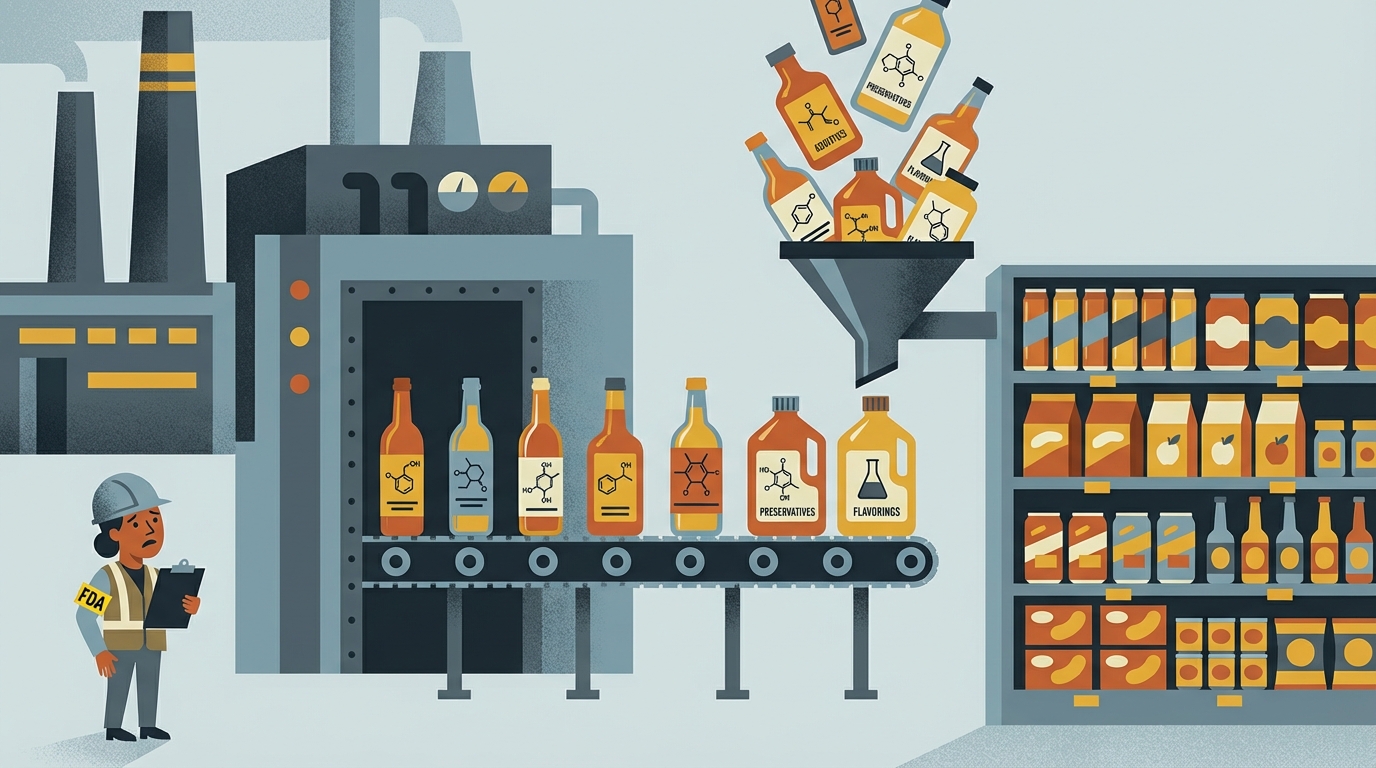
99% of Food Chemicals Since 2000 Were Approved by Industry, Not the FDA
Ninety-nine percent of new chemicals introduced into food and food packaging in the United States since 2000 were approved not by the FDA, but by the food and chemical companies that manufactured them. That figure, drawn from a 2022 analysis cited by Food Dive, represents one of the largest regulatory blind spots in the American food system.
On March 10, 2025, HHS Secretary Robert F. Kennedy Jr. announced he was going after it.
Speaking at the Consumer Federation of America's National Food Policy Conference, Kennedy directed the FDA to explore rulemaking that would end the GRAS (Generally Recognized as Safe) self-certification pathway. Under this system, companies have added thousands of chemicals to the food supply without ever notifying the FDA or the public.
"For far too long, ingredient manufacturers and sponsors have exploited a loophole that has allowed new ingredients and chemicals, often with unknown safety data, to be introduced into the U.S. food supply without notification to the FDA or the public," Kennedy said in the HHS statement, as reported by Civil Eats on March 11, 2025.
How the GRAS System Was Designed to Work
The GRAS exception dates back to 1958, when Congress amended the Federal Food, Drug, and Cosmetic Act to exempt common, well-understood ingredients from formal FDA approval. The original list covered staples: vinegar, baking soda, garlic, cooking oil. These substances had centuries of safe use behind them, and formal review seemed unnecessary.
For the first three decades, the FDA maintained a review process for companies that wanted to add new substances to the GRAS list. But by 1997, the agency had fallen behind. According to analysis by the law firm Skadden, Arps, the FDA abandoned a 30-year GRAS review due to time and resource limitations. In its place, the agency created a voluntary notification program. Companies could submit GRAS notices to the FDA if they chose to, but submission was not required.
That voluntary system became the norm. According to Food Safety News, the FDA now handles roughly 75 GRAS notices annually and has published over 1,000 since the program began. But those 1,000 notifications represent only a fraction of the chemicals that have entered the food supply through the GRAS pathway.
The Self-Certification Problem
The real issue is not the GRAS notices the FDA does receive. It is the ones it never sees.
Under the current system, a food or chemical company can convene its own panel of experts, determine that a new substance is "generally recognized as safe," and begin adding it to food products without ever telling the FDA. This is known as the "self-affirmed GRAS" pathway, and according to NutraIngredients, companies can make these determinations using independent expert panels with no FDA notification required.
A 2013 study by the Pew Charitable Trusts estimated that approximately 3,000 GRAS substances had entered the food supply without any FDA review, according to Food Safety News. Three thousand chemicals. In the food Americans eat every day. And the federal agency charged with food safety never evaluated them.
"Chemical companies, not the FDA, review 99% of food chemicals for safety," said Scott Faber, Senior Vice President for Government Affairs at the Environmental Working Group, as quoted by Food Safety News.
What Kennedy's Directive Would Change
Kennedy's directive instructs the FDA to revise its GRAS final rule to require companies to notify the agency and submit safety data before new food ingredients enter commerce. According to Skadden's legal analysis published March 13, 2025, this would mean eliminating the self-affirmed GRAS pathway entirely.
The HHS statement also indicated the agency is "committed to working with Congress to explore ways legislation can completely close the GRAS loophole," according to Civil Eats.
But there are significant obstacles.
The GRAS exception is written into federal statute, not just FDA regulation. To fully eliminate it, Congress would need to act. Specifically, the FDA would need to amend 21 CFR 170.30, and because the exemption is baked into the underlying law, regulatory action alone may not be enough, according to Skadden's analysis.
A Trump executive order adds another wrinkle: it requires that 10 existing regulations be withdrawn for every new regulation adopted. Skadden's legal analysis flagged this as a potential barrier to GRAS reform.
Then there is the funding gap. According to Food Safety News, the FDA's food safety budget sits at approximately $1 billion. The food industry it regulates generates roughly $2 trillion in annual revenue. Even with political will, the FDA would need significant additional capacity to review the substances currently bypassing its oversight.
Industry Response: Innovation vs. Safety
The announcement split along predictable lines. Consumer advocacy groups welcomed the move. Industry trade organizations warned against going too far.
The Consumer Brands Association, which represents major food companies including PepsiCo and Kraft Heinz, expressed concern that mandatory reviews could slow innovation, according to Food Safety News. The Natural Products Association and the Council for Responsible Nutrition, as reported by NutraIngredients, supported exploring improvements to the system but cautioned against eliminating the self-affirmed GRAS pathway altogether.
The tension is familiar: industry argues that self-certification allows safe ingredients to reach the market faster, while consumer advocates argue that speed without independent review is precisely the problem.
States Are Not Waiting
While federal reform remains uncertain, state governments have already begun taking action on their own. According to Skadden's analysis, California and over a dozen other states have banned specific food additives, including potassium bromate, that the federal government still permits.
These state-level bans reflect growing public frustration with the pace of federal food safety regulation. They also create a patchwork of rules that complicate compliance for food manufacturers operating nationally.
What This Means for You
Kennedy's directive is the strongest federal acknowledgment in decades that the GRAS system is broken. But read the language carefully. The HHS statement directs the FDA to "take steps to explore" revising its rules. It does not commit to action. Closing the loophole requires Congressional legislation, adequate funding, and sustained political will. None of that is guaranteed.
In the meantime, the approximately 3,000 chemicals that entered the food supply without FDA review are still there. They are in processed foods, food packaging, and products on grocery store shelves right now. The GRAS label on an ingredient does not mean the FDA reviewed it. In most cases, it means a company decided it was safe on its own.
For consumers who want to know what is actually in their food, independent tools are filling the gap that regulators have left open. Apps like VeriFoods allow users to scan product barcodes and check whether items contain ingredients that have been independently tested or flagged for safety concerns, regardless of whether those ingredients received FDA review.
Whether or not the GRAS loophole eventually closes, the chemicals already in the food supply are not going anywhere. Knowing what you are eating remains a personal responsibility.
Sources
- https://civileats.com/2025/03/11/kennedy-directs-fda-to-explore-revising-controversial-gras-food-additive-rules/
- https://www.foodsafetynews.com/2025/03/gras-no-more-kennedy-moves-to-end-self-affirmed-food-additives/
- https://www.skadden.com/insights/publications/2025/03/closing-the-gras-loophole-secretary-kennedys-plan-to-enhance-fda-food-safety-regulations
- https://www.fooddive.com/news/rfk-fda-food-additives-ingredients-gras-loophole/742495/
- https://www.nutraingredients.com/Article/2025/03/11/secretary-kennedy-asks-fda-to-exlore-the-elimination-of-self-affirmed-gras-loophole/