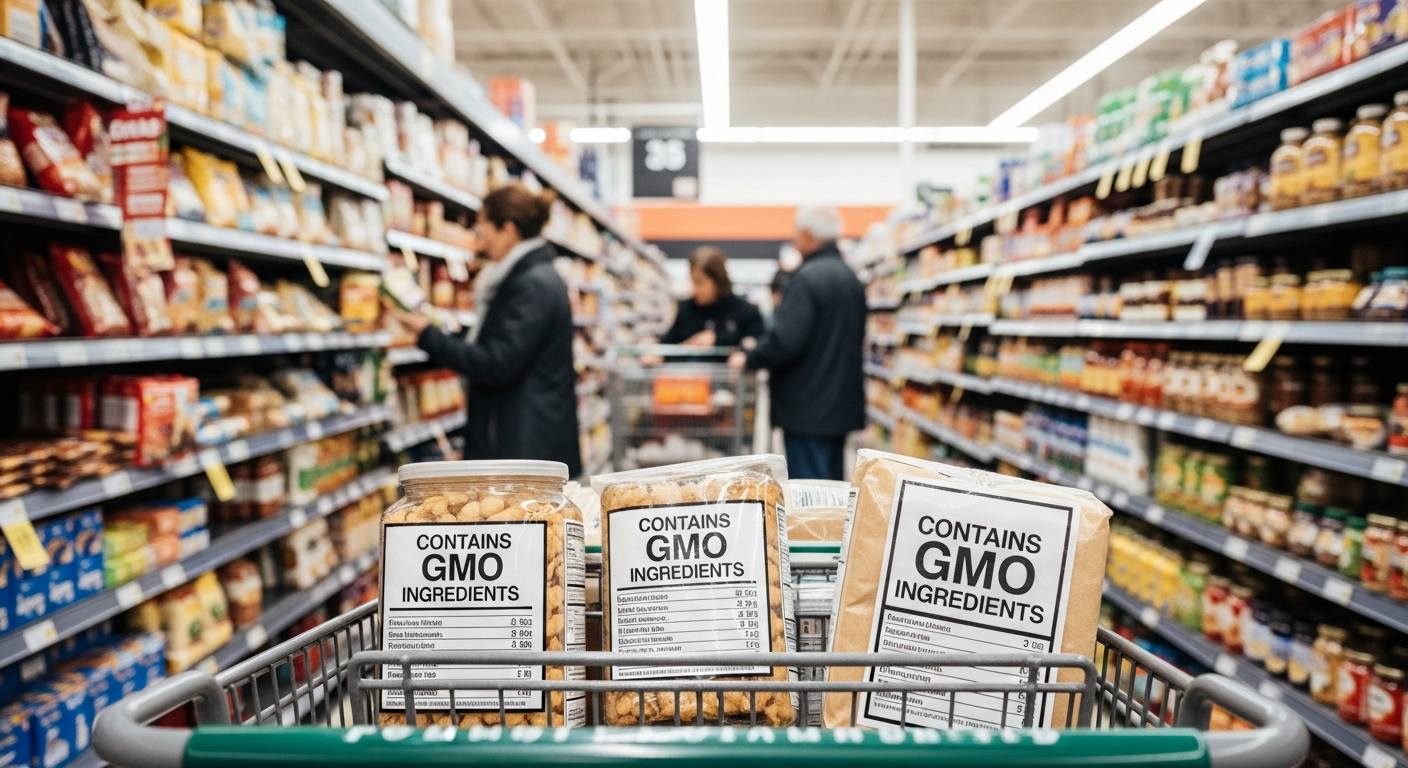
Court Rules Millions of Products Must Now Disclose GMO Ingredients
The corn syrup in your soda, the soybean oil in your salad dressing, and the sugar in your cereal likely come from genetically modified crops. Until now, none of these products were required to tell you that. A federal court just changed the rules.
The Ruling
On October 31, 2025, a three-judge panel of the United States Court of Appeals for the Ninth Circuit issued a landmark decision in Natural Grocers et al. v. Rollins, striking down key provisions of the USDA's National Bioengineered Food Disclosure Standard. The ruling addresses three major issues that have shaped how GMO information reaches American consumers.
The most significant finding concerns "highly refined" foods. Under the previous USDA rule, products made from genetically modified crops but processed to the point where modified DNA was no longer detectable were exempt from labeling. This exemption covered a vast range of everyday staples: high-fructose corn syrup, canola oil, soybean oil, beet sugar, and countless processed ingredients derived from GMO crops.
The court rejected this exemption outright, holding that "non-detectability" under the regulation cannot be equated with "non-presence." In other words, just because current testing methods cannot detect modified genetic material in a highly refined product does not mean the product was not made from genetically engineered organisms.
QR Codes Struck Down
The court also invalidated the USDA's allowance of QR codes and text-message-based disclosures as the sole method of GMO labeling. Under the previous rule, manufacturers could place a QR code on their packaging instead of a written disclosure, directing consumers to scan the code with a smartphone to learn whether the product contained bioengineered ingredients.
The Ninth Circuit found that this approach does not guarantee meaningful access to GMO information. People without smartphones, those in areas with limited internet connectivity, elderly consumers unfamiliar with QR technology, and shoppers in a hurry at the grocery store are all effectively denied the information that on-package text would provide.
The court remanded this portion of the case to the district court with instructions to vacate the QR code and text message disclosure regulations.
What This Means for Consumers
The practical impact of this ruling is potentially enormous. The USDA must now revisit and rewrite the National Bioengineered Food Disclosure Standard. When the revised rules take effect, millions of products that were previously exempt from GMO labeling could require on-package disclosure.
Consider the scope. Corn is the most widely grown crop in the United States, and the vast majority of it is genetically modified. Corn derivatives, including high-fructose corn syrup, corn starch, and corn oil, appear in thousands of processed foods. Soybean oil, derived almost entirely from GMO soybeans, is the most consumed cooking oil in America. Sugar from genetically modified sugar beets accounts for roughly 55 percent of domestically produced sugar.
All of these products were shielded from labeling under the highly refined exemption. That shield has now been struck down.
Industry Response
The food industry faces significant compliance challenges. Reformulating packaging, tracing ingredient supply chains back to their genetic origins, and implementing new labeling systems all carry substantial costs. Industry groups have advocated for federal preemption legislation that would establish a single national standard, potentially limiting the scope of required disclosures.
The timeline for new rules remains uncertain. The USDA must publish a revised rule for public comment, receive and address feedback, and finalize the regulation. This process typically takes one to two years, though political priorities and legal challenges could extend or shorten that timeline.
The Broader Transparency Movement
This ruling arrives in the context of a broader push for food transparency across the United States. More than 38 states introduced food additive legislation in 2025. The MAHA Commission published a sweeping strategy report calling for mandatory GRAS notices and front-of-pack labeling reform. Consumer demand for ingredient transparency continues to rise, with surveys showing over 80 percent of American shoppers prioritize knowing what is in their food.
The Ninth Circuit's decision reinforces a straightforward principle: consumers have the right to know what is in their food, and labeling methods must actually deliver that information in an accessible way.
Sources
- Ninth Circuit Court of Appeals - "Natural Grocers v. Rollins, Case No. 22-16770" - October 31, 2025. https://cdn.ca9.uscourts.gov/datastore/opinions/2025/10/31/22-16770.pdf
- Davis Wright Tremaine - "What the Ninth Circuit Ruling on the Mandatory GMO Labeling Rule Means for F+B Businesses" - November 2025. https://www.dwt.com/insights/2025/11/9th-circuit-ruling-food-bev-mandatory-gmo-labeling
- Covington & Burling - "Ninth Circuit Invalidates USDA's Exemption for Highly Refined Foods Under the National Bioengineered Food Disclosure Standard" - November 2025. https://www.cov.com/en/news-and-insights/insights/2025/11/ninth-circuit-invalidates-usdas-exemption-for-highly-refined-foods-under-the-national-bioengineered-food-disclosure-standard
- Wiley Law - "Ninth Circuit Upends USDA's Bioengineered Food Disclosure Requirements" - November 2025. https://www.wiley.law/alert-Ninth-Circuit-Upends-USDAs-Bioengineered-Food-Disclosure-Requirements
- Perkins Coie - "Ninth Circuit Issues Significant Ruling on Bioengineered Food Disclosure Standard" - November 2025. https://perkinscoie.com/insights/update/ninth-circuit-issues-significant-ruling-bioengineered-food-disclosure-standard
Related Articles

The FDA Promised to Ban Artificial Food Dyes. Instead, It Rewrote the Rules.
The FDA quietly abandoned its pledge to eliminate six synthetic food dyes by 2026, pushed the deadline to 2027, and...
Texas Becomes First State to Require Warning Labels on Foods with Additives Banned in Other Countries
Texas Governor Greg Abbott signed SB 25, the "Make Texas Healthy Again" bill, mandating bold warning labels on packaged...
Federal Dietary Guidelines Now Warn Against Seed Oils and Ultra-Processed Foods
The 2025-2030 Dietary Guidelines for Americans mark a historic shift: for the first time, the federal government...