Fact Check: Did Trump Sign an Executive Order Shielding Glyphosate Makers From Lawsuits?
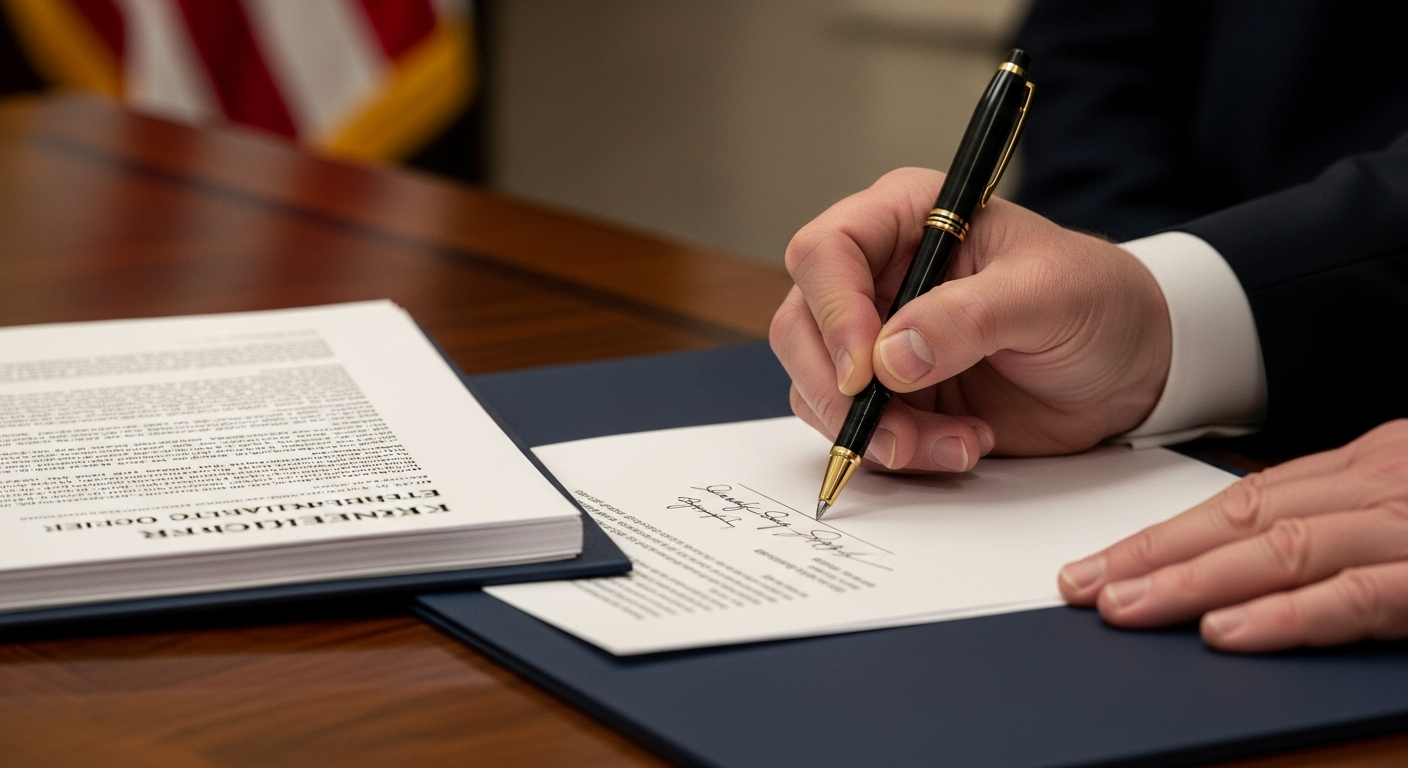
Yes. On February 18, 2026, President Trump signed an executive order invoking the Defense Production Act to boost domestic production of glyphosate, the active ingredient in Roundup. The order declares glyphosate "central to American economic and national security" and grants legal immunity to domestic manufacturers producing under the order. That manufacturer, in practice, is one company: Bayer, the parent of Monsanto, which is currently facing more than 60,000 cancer-related lawsuits over Roundup. The order does not declare glyphosate "safe." But critics say it achieves the same practical outcome by shielding the only company that makes it in America from state-level liability.
Here is what the order actually says, who it protects, and why it has turned Trump's own health-focused supporters against him.
What the Executive Order Does
The order invokes the Defense Production Act (DPA), a Korean War-era law originally designed to ensure the U.S. could produce enough military equipment during wartime. The DPA gives the president broad authority to direct private companies to prioritize production of materials deemed essential to national defense.
Trump's order applies this framework to two chemicals: elemental phosphorus and glyphosate-based herbicides. The White House fact sheet stated that "the threat of reduced or ceased production gravely endangers national security and defense, which includes food-supply security."
The critical provision is Section 707 of the DPA. Under this section, companies that produce glyphosate in compliance with the executive order receive legal immunity from lawsuits related to that production. In plain language, if Bayer manufactures glyphosate as directed by the order, plaintiffs in state courts cannot hold the company liable for harms caused by those products.
This matters because Bayer is the only domestic producer of glyphosate in the United States. The immunity provision applies broadly to any domestic manufacturer, but there is only one. The company had been negotiating a proposed $7.25 billion settlement to resolve tens of thousands of existing cancer claims before the order was signed.
The MAHA Revolt
The backlash came from an unexpected direction, Trump's own base.
The Make America Healthy Again (MAHA) movement, which had rallied behind Robert F. Kennedy Jr.'s appointment as Health and Human Services Secretary, called the order "outrageous." David Murphy, former campaign finance director for Kennedy's presidential run, said it was "the biggest anti-MAHA initiative the administration has launched."
Activist Kelly Ryerson reported receiving "hundreds" of emails from voters who said they now regret supporting Trump because of the order. Zen Honeycutt, founder of Moms Across America, told CNN, "I was actually sick to my stomach."
Rep. Thomas Massie (R-KY) responded by drafting legislation to block the order's implementation.
The most striking tension involves Kennedy himself. Before joining the Trump administration, Kennedy won a $290 million jury verdict on behalf of Dewayne Johnson, a California groundskeeper who developed non-Hodgkin lymphoma after years of Roundup exposure. That case became a landmark in the fight against glyphosate. Now, as a member of the administration, Kennedy has defended the executive order, citing national defense priorities.
What the Science Says About Glyphosate
The scientific debate over glyphosate has been running for more than a decade, and two major institutions have reached opposite conclusions.
In 2015, the International Agency for Research on Cancer (IARC), a branch of the World Health Organization, classified glyphosate as "probably carcinogenic to humans," placing it in Group 2A. That classification was based on evidence linking glyphosate exposure to non-Hodgkin lymphoma in agricultural workers. Two large meta-analyses found a 41% increased risk of non-Hodgkin lymphoma among people with the highest levels of glyphosate exposure, according to CNN and Newsweek reporting on the studies.
The U.S. Environmental Protection Agency (EPA) reached a different conclusion. The agency maintains that glyphosate is "unlikely to be a human carcinogen" based on its own review of available studies.
Melissa Perry, a public health professor at George Mason University, told Newsweek: "This is not a chemical with zero risk. The weight of independent scientific evidence supports caution, not complacency."
Meanwhile, glyphosate has become what Newsweek described as "ubiquitous in soil, water, and food systems." It is the most widely used herbicide in the world, and residues appear in products far removed from agriculture.
What This Means for You
The legal immunity provision removes one of the most powerful mechanisms that has historically forced chemical manufacturers to reconsider their products. Lawsuits drive reformulation. They fund independent research. They produce internal documents that reveal what companies knew and when. With that pressure reduced, the burden shifts to consumers and independent organizations to identify contamination.
Florida state testing under the Healthy Florida First initiative found glyphosate in 75% of bread products tested, a finding that does not depend on regulatory classification or legal proceedings. Independent government testing like this becomes the primary form of consumer protection when liability shields are in place.
The executive order does not make glyphosate safer or more dangerous. What it does is change who bears the consequences of exposure. Before the order, a cancer patient could sue the manufacturer. After the order, that path is significantly narrowed for products made under the DPA framework. The chemical remains the same. The accountability structure around it has changed.
Stay ahead of the label.
Get early access to VeriFoods and be the first to see what's really in your food.
Sources
- The White House - "Promoting the National Defense by Ensuring an Adequate Supply of Elemental Phosphorus and Glyphosate-Based Herbicides" - February 18, 2026. https://www.whitehouse.gov/presidential-actions/2026/02/promoting-the-national-defense-by-ensuring-an-adequate-supply-of-elemental-phosphorus-and-glyphosate-based-herbicides/
- CNN - "What to know about glyphosate, the herbicide behind a Trump executive order that's angered MAHA moms" - February 24, 2026. https://www.cnn.com/2026/02/24/health/maha-trump-glyphosate-health
- The Hill - "Glyphosate executive order draws MAHA opposition" - February 2026. https://thehill.com/policy/energy-environment/5745981-glyphosate-trump-order-maha-opposition/
- Newsweek - "How Safe Is Glyphosate Chemical Backed by Trump? What the Science Says" - February 20, 2026. https://www.newsweek.com/how-safe-is-glyphosate-chemical-backed-trump-what-science-says-11553522