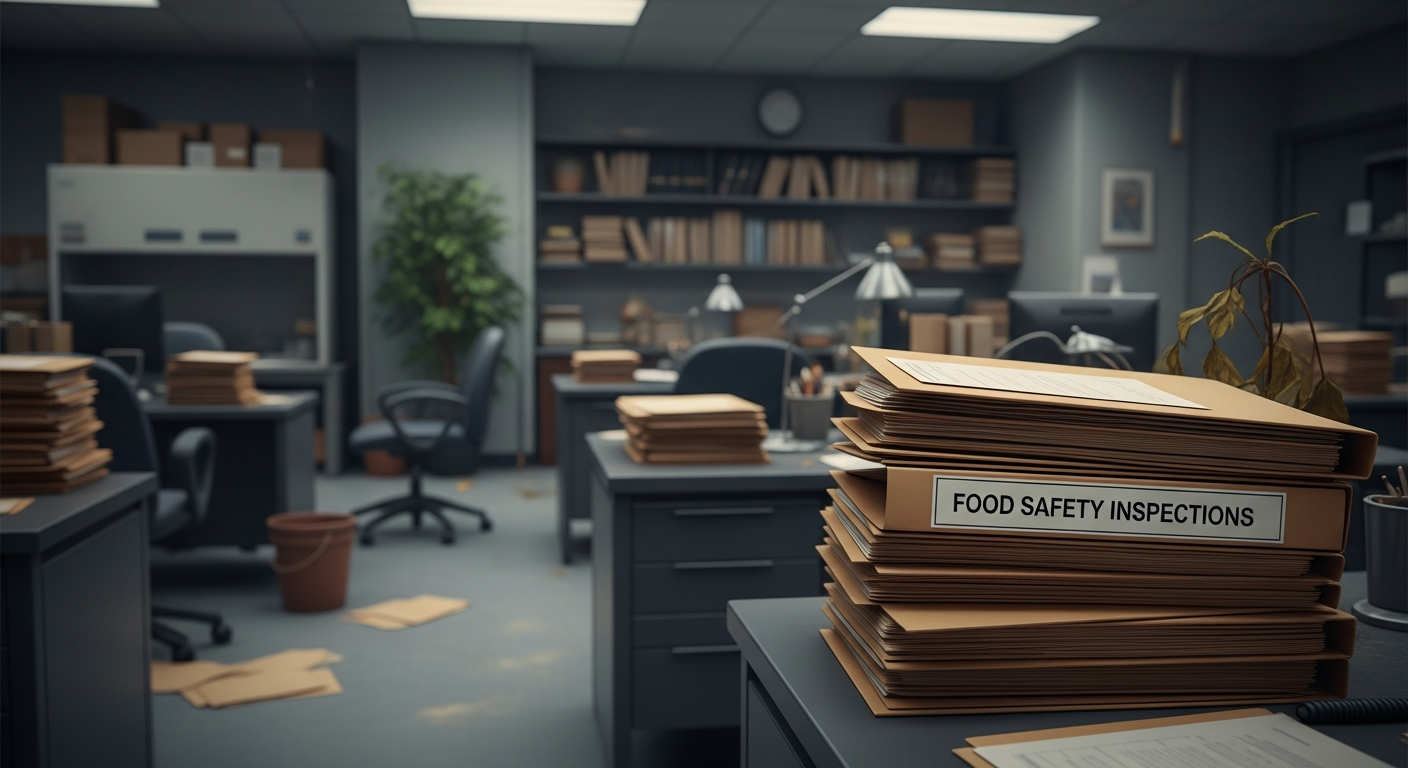
FDA Lost 4,300 Staff in 2025. Here's What That Means for Your Food Safety.
Someone is supposed to be checking the food you eat. Inspecting the factories that produce it. Testing imports for contamination. Tracking outbreaks when people get sick. In 2025, the agency responsible for all of this lost more than 4,300 employees, and the consequences are already showing up on grocery store shelves.
The U.S. Food and Drug Administration, which oversees the safety of approximately 80% of the American food supply, saw its workforce reduced by 3,859 staffers in fiscal year 2025 and an additional 473 in fiscal year 2026. The cuts resulted from a combination of hiring freezes, early retirement incentives, reductions in force, and the Deferred Resignation Program, all part of broader federal workforce reductions that have eliminated 242,260 federal employees since January 2025.
The numbers are not abstract. They translate directly into fewer inspections, slower outbreak responses, and less oversight of the food Americans eat every day.
The Inspection Collapse
The FDA's food inspection workforce now stands at 470 inspectors out of a ceiling of 589 positions, a shortfall of 20%. But the raw headcount understates the operational impact.
Foreign food inspections have been hit hardest. According to a ProPublica analysis, the number of foreign food facility inspections dropped by nearly half in March 2025 compared to the monthly average over the prior two years. This matters because approximately 15% of the U.S. food supply is imported, including 50% of fresh fruits and 20% of vegetables.
The FDA is now conducting the fewest inspections of imported food since 2011, excluding the pandemic period. With fewer inspectors verifying that overseas producers meet U.S. safety standards, contaminated food has a wider path to American plates.
Making matters worse, 65% of the support staff responsible for travel logistics, budgets, and coordination were eliminated. Remaining inspectors now spend time booking their own travel, obtaining diplomatic passports and visas, and coordinating directly with foreign authorities, further reducing the hours available for actual food safety work.
FoodNet: The Early Warning System Goes Quiet
In July 2025, the administration quietly scaled back the Foodborne Diseases Active Surveillance Network, known as FoodNet, one of the country's primary systems for detecting foodborne illness outbreaks.
FoodNet previously tracked multiple dangerous pathogens across its surveillance sites. After the cuts, it was reduced to monitoring just two: Salmonella and a common type of E. coli. Pathogens like Listeria, Campylobacter, Vibrio, and Cyclospora, which collectively cause thousands of hospitalizations each year, lost their dedicated surveillance.
This is the equivalent of removing smoke detectors from most of the rooms in your house and hoping any fire starts in the two rooms that still have them. Outbreaks caused by the no-longer-monitored pathogens will still happen. They will just take longer to detect, spread further before they are identified, and sicken more people before a response is mounted.
Real Consequences Are Already Visible
The weakened system showed its vulnerabilities in December 2025 when the ByHeart infant formula botulism outbreak exposed critical failures in recall enforcement. After the FDA expanded the recall to include all ByHeart formula ever produced, inspectors found the recalled product still sitting on store shelves in more than 175 locations across 36 states, in some cases more than three weeks after the recall was issued.
The FDA sent warning letters to Kroger, Target, Albertsons, and Walmart, but the damage was done. Fifty-one infants across 19 states developed suspected or confirmed botulism. An agency with more staff and faster response capabilities might have removed those products sooner.
Separately, a massive December recall at Gold Star Distribution in Minnesota revealed that food products had been stored alongside rodent urine and bird droppings, with contaminated items distributed to more than 50 stores. These are the kinds of facility failures that routine inspections are designed to catch.
Legislative Restrictions Compound the Problem
Beyond workforce cuts, the fiscal year 2026 appropriations bill further restricted the FDA's enforcement authority. The bill prohibited the agency from enforcing the Food Traceability Rule until 2028, a regulation that would have enabled faster identification of contamination sources during outbreaks. It also restricted enforcement of the Produce Safety Rule and the Pre-Harvest Agricultural Water Rule for certain crops.
The combined effect is a regulatory agency that has fewer people, less authority, and reduced surveillance capabilities, all at a time when the food supply chain is growing more complex and globalized.
Expert Warnings
Food safety professionals have been sounding alarms throughout 2025. The Government Accountability Office published a report noting that "overseeing food and drug safety is getting harder at FDA." Food Safety Magazine characterized 2026 as a "perfect storm" for food safety failures.
CBS News reported that the FDA was considering plans to end routine food safety inspections entirely, a move that would represent the most significant retreat from federal food oversight in the agency's history.
"Every single thing to prevent, control, or clean up contamination to protect human health is being delayed and undermined," said Dr. Betsy Southerland, a former EPA official, in comments that food safety advocates have applied broadly to the current regulatory environment.
What This Means for Consumers
The practical implications are straightforward. With fewer inspectors, more contaminated food reaches consumers. With reduced surveillance, outbreaks spread further before detection. With weakened enforcement authority, the rules that remain on the books have diminished effect.
Consumers cannot rely on the assumption that someone is checking the safety of their food the way they could a decade ago. The inspection infrastructure has been materially weakened, and rebuilding it will take years even if the political will to do so emerges.
In this environment, independent information about food safety becomes essential. Knowing which products have been tested, which contain concerning chemicals or contaminants, and which have safety profiles that regulators are no longer monitoring is no longer a luxury. It is a necessity.
The people whose job it was to protect your food supply just lost 4,300 colleagues. The food supply did not get any safer.
Sources
STAT News - "American food safety could be headed for a breakdown" - December 22, 2025. https://www.statnews.com/2025/12/22/american-food-safety-funding-cuts-foodnet/
Food Safety Magazine - "A 2025 Timeline of U.S. Federal Food Safety Changes Under the Trump Admin" - 2025. https://www.food-safety.com/articles/11004-a-2025-timeline-of-us-federal-food-safety-changes-under-the-trump-admin
Food Safety Magazine - "FDA, USDA, CDC Continue to Lose Staffers in Fiscal Year 2026" - 2026. https://www.food-safety.com/articles/11133-fda-usda-cdc-continue-to-lose-staffers-in-fiscal-year-2026
ProPublica - "Foreign Food Safety Inspections Hit Historic Low After Trump Cuts" - 2025. https://www.propublica.org/article/foreign-food-safety-inspections-historic-low-fda
U.S. Government Accountability Office - "Overseeing Food and Drug Safety is Getting Harder at FDA" - 2025. https://www.gao.gov/blog/overseeing-food-and-drug-safety-getting-harder-fda
NPR - "How FDA cuts could make the food and drug supply less safe" - April 2025. https://www.npr.org/sections/shots-health-news/2025/04/18/nx-s1-5364544/fda-inspections-layoffs-food-and-drug-supply-less-safe
CBS News - "FDA making plans to end its routine food safety inspections, sources say" - 2025. https://www.cbsnews.com/news/fda-food-safety-inspections-plans/
Related Articles
Trump Grants Glyphosate Makers Legal Immunity Under Defense Production Act
President Trump signed an executive order on February 18, 2026 invoking the Defense Production Act to shield glyphosate...
The GRAS Loophole Is Closing: Senate Bill Would Force Companies to Disclose Every Food Ingredient to FDA
The Better Food Disclosure Act, introduced November 6, 2025, would end the self-affirmed GRAS pathway that has allowed...
FDA Finds PFAS in Your Food But Refuses to Set Safety Limits
The FDA's own testing found PFAS 'forever chemicals' in 7% of food samples — including shrimp, beef, chicken, and milk...