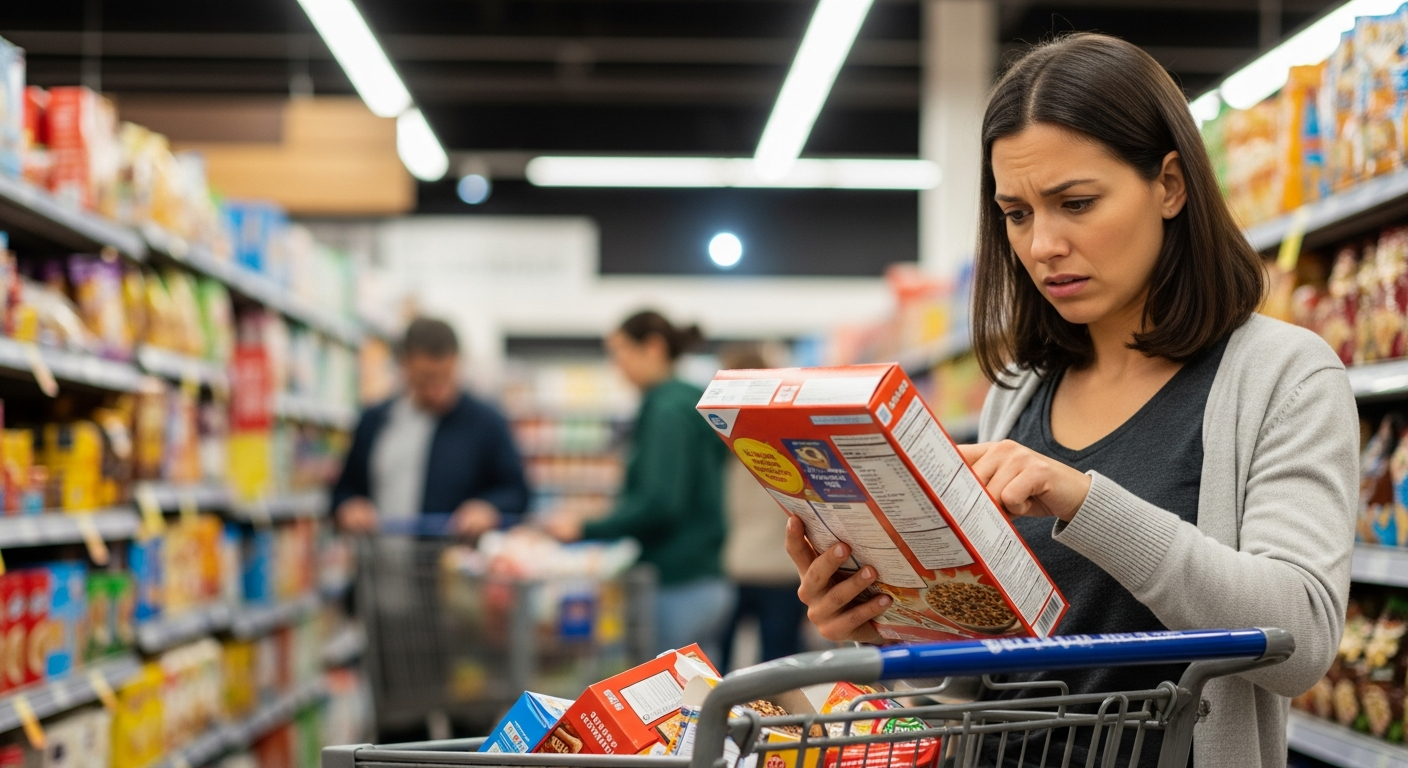
111 Chemicals Were Secretly Added to Your Food. The FDA Had No Idea.
At least 111 chemicals of unknown safety have been added to foods, drinks, and supplements sold in the United States without the FDA ever being told. That is the central finding of a new investigation published March 3, 2026 by the Environmental Working Group, which tracked substances that entered the American food supply through a regulatory loophole that lets companies decide for themselves whether their ingredients are safe.
Of those 111 chemicals, 49 were identified in roughly 4,000 products listed in the USDA's FoodData Central database. The rest may be in products that are not publicly cataloged. In both cases, the FDA received no notification and conducted no safety review.
"Food companies are deciding on their own to secretly add unreviewed chemical ingredients to products instead of following existing federal guidelines," said Melanie Benesh, EWG's vice president, in the organization's press release.
Context
The investigation centers on the GRAS (Generally Recognized as Safe) designation, a federal loophole created in 1958 to exempt well-known ingredients like vinegar, salt, and baking soda from formal FDA review. The logic was simple: substances with centuries of safe use did not need a government stamp of approval.
But the system has mutated far beyond its original intent. In 1997, the FDA replaced its formal GRAS review process with a voluntary notification system. Companies could submit safety data to the agency if they wanted to, but they were not required to. The result: manufacturers began convening their own expert panels, declaring their own ingredients safe, and adding them to food products without any federal oversight.
A 2022 EWG analysis found that nearly 99% of new chemicals used in food or food packaging since 2000 were approved not by the FDA, but by the food and chemical industry itself. During the same period, manufacturers submitted only 10 GRAS requests directly to the FDA. When the FDA did receive voluntary submissions, the agency rejected or triggered the withdrawal of one in five requests, a rate that suggests its review process catches problems the industry's self-assessment does not.
"This is a wake-up call for every American who assumes the FDA is reviewing the safety of chemicals in their food," Benesh said.
The Findings
The EWG investigation did not just count chemicals. It identified specific substances already sitting in thousands of grocery store products.
Green tea extracts appeared in 901 products, including granola bars, candy, sodas, and flavored waters. These are not the same as brewed green tea. Concentrated green tea extracts contain high levels of EGCG (epigallocatechin gallate), a compound the European Food Safety Authority has linked to liver injury at doses above 800 milligrams per day. More than 100 cases of severe liver damage have been documented in medical literature. The EFSA now requires warning labels on supplements containing green tea catechins in the EU. In the United States, concentrated green tea extracts in food products have never been reviewed by the FDA.
Aloe vera extracts turned up in more than 450 products, primarily juices and nectars. Unpurified whole-leaf aloe vera extract contains compounds the FDA itself considers dangerous. The agency banned aloe vera in over-the-counter laxatives in 2002 after linking it to cancer and kidney failure. Despite that ban, aloe vera extracts continue to appear in food products through self-affirmed GRAS determinations.
Mushroom extracts were found in 428 products, from coffee blends to soups. While many mushroom species are safe, the wrong species can be lethal. In 2024, the FDA issued a warning about Amanita muscaria mushroom appearing in food products, a species that contains neurotoxic compounds. The mushroom extracts identified by EWG had not been submitted for FDA review.
The investigation also flagged 22 additional natural extracts, including concentrated versions of cinnamon, cocoa, cranberry seed oil, grape skins, hemp, and lemon balm. In each case, the concentrated extract behaves differently in the body than the whole food it is derived from.
"You should be able to test that extract or cocktail if it is going to be in the marketplace," said Maricel Maffini, a biochemist and former Tufts University researcher, in the CNN investigation.
What Happens When It Goes Wrong
The EWG report points to a 2022 case that shows exactly what can happen when untested ingredients reach consumers.
Tara flour, derived from Peruvian carob seed pods, entered the food supply through a self-affirmed GRAS determination. It was added to meat substitutes and other products without FDA notification. Within months, the agency received 470 complaints of gastrointestinal illness and organ damage. Content creator Luke Wesley Pearson underwent emergency gallbladder surgery after consuming a product containing tara flour. Two additional consumers reported the same surgery.
The FDA took two years to remove tara flour from the GRAS list. For those two years, the ingredient remained legally available in the American food supply.
"This incident shows how broken our food regulatory system is. It's completely backwards," said Dr. Pieter Cohen, a professor at Harvard Medical School, in the CNN investigation.
What Experts Say
The investigation drew reactions from researchers across multiple countries.
Mathilde Touvier, a researcher at France's National Institute of Health and Medical Research, called the self-certification system fundamentally flawed. "It is highly problematic that companies are allowed to self-determine their own ingredients are 'GRAS,' given the obvious financial conflict of interest," she said.
Emily Broad Leib, a professor at Harvard Law School, framed the problem in broader terms. "The public and regulators are flying blind when it comes to the safety of many substances," she said in the EWG press release.
The regulatory response so far has been incremental. In September 2025, the FDA announced it would explore rulemaking to close the self-affirmed GRAS pathway, according to Food Dive. Andrew Nixon, HHS Deputy Assistant Secretary, said the administration aims to "close gaps and restore public trust" through greater notification requirements, enhanced interagency review, and proposed rulemaking.
But Dr. Cohen was skeptical. "The administration is basically asking the industry politely to adhere to the intent of the law, which is no different than the situation we have now," he told CNN. "I've seen nothing game-changing in terms of improving the safety of our food supply."
Meanwhile, states are moving faster than the federal government. Over 30 states introduced GRAS transparency legislation in 2025, according to EWG. Arizona, California, and Texas have already enacted bans or labeling requirements targeting specific food additives.
The food industry, for its part, acknowledged the need for reform. Sarah Gallo of the Consumer Brands Association said the organization supports GRAS reform and advocates for federal legislation establishing "national uniformity for ingredient safety and disclosure." She added that the U.S. maintains "one of the safest and most highly regulated food systems in the world."
What This Means for You
The 111 chemicals identified by EWG represent only the ones investigators were able to find. Because self-affirmed GRAS determinations are secret by design, the actual number of unreviewed substances in the food supply is almost certainly higher. A 2014 report by the Natural Resources Defense Council found that 56 companies relied on undisclosed GRAS determinations for 275 chemicals, and that was over a decade ago.
Federal reform, if it comes, will not be retroactive. The chemicals already in the food supply will stay there unless specifically targeted for removal. Even butylated hydroxyanisole (BHA), classified as a possible human carcinogen by the International Agency for Research on Cancer and listed as a hormone-disrupting chemical by the EU, has been in the American food supply since a doctor first petitioned the FDA for a ban in 1990. The FDA only announced it would re-examine BHA in February 2026, 36 years later.
The regulatory system was designed for vinegar and baking soda. It is now being used to approve concentrated plant extracts, alternative proteins, and novel chemical compounds with no public safety data. Until that system changes, knowing what is in your food falls to you.
VeriFoods scans products for additives, contaminants, and ingredients that regulatory agencies have flagged or failed to review. When the system designed to protect you is not working, independent verification is not optional.
Sources
- CTV News / CNN - "Investigation finds 'secretly' added chemicals of unknown safety in US food supply" - March 3, 2026. https://www.ctvnews.ca/health/article/investigation-finds-secretly-added-chemicals-of-unknown-safety-in-us-food-supply/
- Environmental Working Group - "Secret Food Chemicals: New Analysis Finds Over 100 Unreviewed Substances Added to Products" - March 3, 2026. https://www.ewg.org/news-insights/news-release/2026/03/secret-food-chemicals-new-analysis-finds-over-100-unreviewed
- Food Dive - "FDA takes first step toward closing GRAS ingredient 'loophole'" - September 11, 2025. https://www.fooddive.com/news/food-ingredient-safety-gras-fda-rule/759938/
- PMC / National Library of Medicine - "Green tea extract-associated acute liver injury: Case report and review" - December 2022. https://pmc.ncbi.nlm.nih.gov/articles/PMC9745259/
- European Food Safety Authority - "Scientific opinion on the safety of green tea catechins" - April 18, 2018. https://efsa.onlinelibrary.wiley.com/doi/10.2903/j.efsa.2018.5239
Related Articles
Texas Becomes First State to Require Warning Labels on Foods with Additives Banned in Other Countries
Texas Governor Greg Abbott signed SB 25, the "Make Texas Healthy Again" bill, mandating bold warning labels on packaged...
83% of Prenatal Vitamins Contain Lead, Peer-Reviewed Study Finds
Prenatal vitamins are the one supplement nearly every obstetrician tells pregnant women to take. A peer-reviewed study...
PFAS in Pesticides: Hidden 'Forever Chemicals' Threaten U.S. Food Supply
By VeriFoods A recent study has brought to light a deeply concerning practice in American agriculture: the intentional...